


Your shopping cart is empty!
Marshmallow (wymote, mortification root)
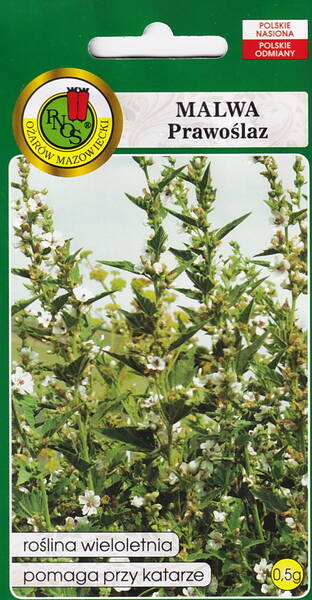
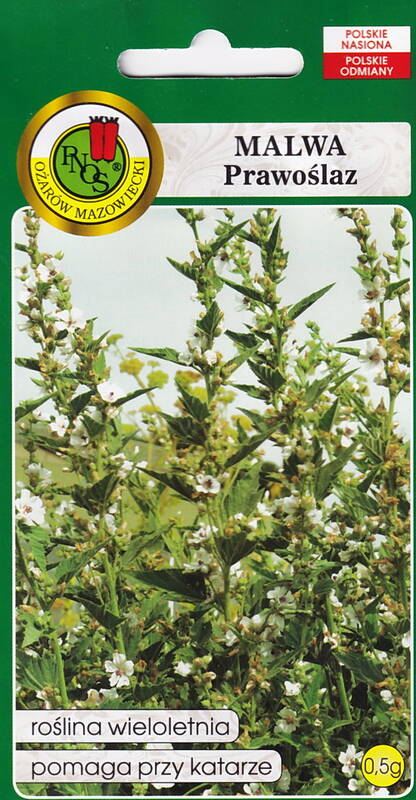
MARSHMALLOW - Althaea officinalis.
Used as a mild expectorant (especially in pediatrics), demulcent (coating), and anti-inflammatory agent for acute and chronic respiratory diseases, gastric ulcers, and duodenal ulcers.
Marshmallow herb contains 35% mucilage, starch, pectin, and minerals. The high content of mucilaginous substances allows marshmallow preparations to cover the mucous membranes of the body with a protective layer for a long time, protecting them from irritation. This facilitates the spontaneous regeneration of damaged tissues and reduces inflammation. Marshmallow has an analgesic and antitussive effect. Teas made from flowers, leaves, and roots are used in medicine.
Agrotechnics.
Seeds are sown in autumn on seedbeds or in February-March for seedlings (indoors). Seeds require preliminary stratification: sow seeds to a depth of no more than 0.5 cm, moisten from a spray bottle, cover with glass, and place in the refrigerator (temperature +5+7°C).
Crops are kept in such conditions for 10–15 days, then transferred to room temperature. It is necessary to monitor humidity and ventilation. At a temperature of +18+20°C, seedlings appear on the 10–14th day. If there is no germination, repeat the "cold-warm" method. Seedlings are pricked out into boxes in the phase of 2–3 true leaves. Seedlings are planted in open ground after 4–6 weeks.
Prefers sunny places or light partial shade with loose, non-acidic soil. Can grow in one place for 5–7 years.
Used as a mild expectorant (especially in pediatrics), demulcent (coating), and anti-inflammatory agent for acute and chronic respiratory diseases, gastric ulcers, and duodenal ulcers.
Marshmallow herb contains 35% mucilage, starch, pectin, and minerals. The high content of mucilaginous substances allows marshmallow preparations to cover the mucous membranes of the body with a protective layer for a long time, protecting them from irritation. This facilitates the spontaneous regeneration of damaged tissues and reduces inflammation. Marshmallow has an analgesic and antitussive effect. Teas made from flowers, leaves, and roots are used in medicine.
Agrotechnics.
Seeds are sown in autumn on seedbeds or in February-March for seedlings (indoors). Seeds require preliminary stratification: sow seeds to a depth of no more than 0.5 cm, moisten from a spray bottle, cover with glass, and place in the refrigerator (temperature +5+7°C).
Crops are kept in such conditions for 10–15 days, then transferred to room temperature. It is necessary to monitor humidity and ventilation. At a temperature of +18+20°C, seedlings appear on the 10–14th day. If there is no germination, repeat the "cold-warm" method. Seedlings are pricked out into boxes in the phase of 2–3 true leaves. Seedlings are planted in open ground after 4–6 weeks.
Prefers sunny places or light partial shade with loose, non-acidic soil. Can grow in one place for 5–7 years.
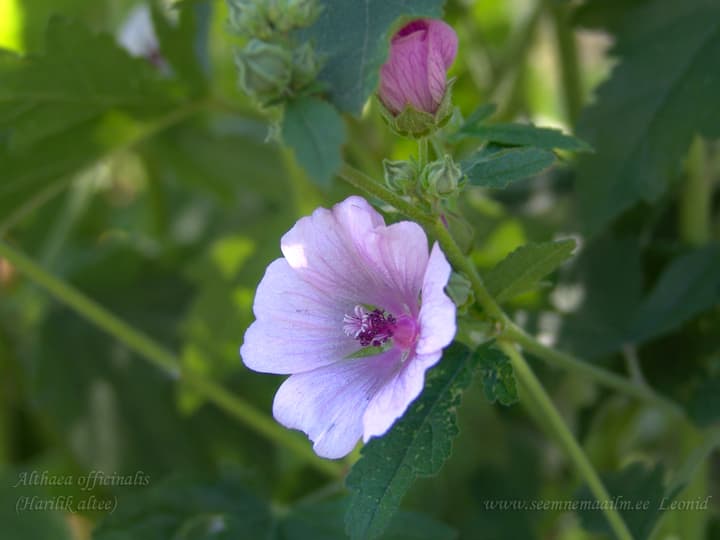
* The name «Althaea» comes from the Greek word «althea», which literally means «to heal». This alone indicates that ancient Greeks and Romans knew this plant well and used it widely for medicinal purposes five centuries BC.
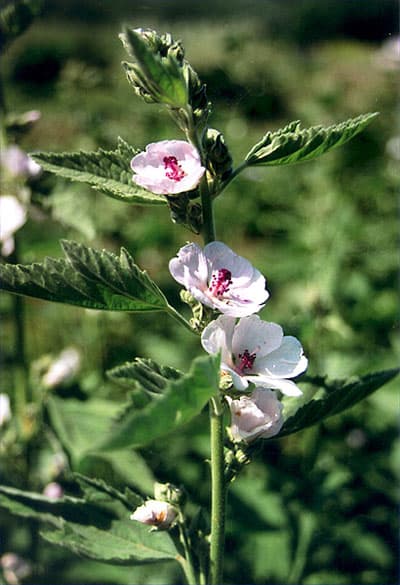
Althaea officinalis is a perennial herbaceous plant. Its straight stems reach a height of 1.2–1.5 meters. In the wild, it is found in damp meadows and river floodplains.
The main medicinal raw material is the roots. The rhizome is thick, with a powerful taproot (up to 50 cm), which becomes woody in the upper part. The leaves are velvety-felted due to dense pubescence, giving the whole plant a grayish-green color.
The plant blooms in the second year. Pale pink flowers adorn the stems for a long time: from June to September.
Chemical composition and benefits:
Roots are exceptionally rich in mucilage (up to 35%) and starch (up to 37%). Infusions and decoctions possess strong enveloping and softening properties. They soothe painful coughs, which is why marshmallow root has long been part of chest blends and children's cough syrups.
Marshmallow root is also widely used in the treatment of gastritis and peptic ulcers, especially with high acidity. Mucous substances coat the affected areas, creating a protective layer for healing.
In folk medicine, the infusion is considered a good remedy for intestinal pain and bladder inflammation, and externally for gargling and eye washing.
Decoction recipe: Pour 1 cup of hot boiled water over 2 tablespoons of chopped roots, heat in boiling water for 30 minutes, then cool. Take warm, 1/3 cup in slow sips 3–4 times a day after meals. Store in the refrigerator for no more than 2 days.
Herbal blends:
1. For bronchitis and asthma: equal parts of marshmallow root and thyme herb. Pour 1 cup of cold water over 2 tablespoons of the mix, let steep for 2 hours, bring to a boil, cool, and strain. Drink 1/3 cup 3 times a day.
2. For pneumonia: marshmallow root (2 parts), coltsfoot leaves (2 parts), oregano herb (1 part).
3. "Trio" blend: equal parts of marshmallow root, licorice root, and elecampane root.
How to grow marshmallow in the garden?
Propagated by seeds (less often by root division). Soils should be fertile and loose. Prepare the bed in autumn: dig to a depth of 25 cm, add rotted manure and fertilizers.
Important: marshmallow seeds must be soaked before spring sowing. Place them on a wet cloth for at least 3 days until swollen. Sow in rows 40–50 cm apart, planting depth 2 cm. Keep the bed weed-free.
Harvesting.
Roots are harvested in autumn of the second year. Dig up carefully, cut off the top, and wash quickly in cold water (no more than 15 minutes to avoid slime release). Cut thick roots lengthwise, others into 15–20 cm pieces.
Dry in the shade or in an oven (+45+55°C). Roots are dry when they break with a crack rather than bend. Store in a tightly closed jar for up to 3 years.
Pharmacy name: root (Althaeae radix), leaves (Althaeae folium), flowers (Althaeae flos).
Interestingly, the medical use of marshmallow has remained virtually unchanged over the centuries — it is still the best natural remedy for soothing coughs and protecting mucous membranes.
Pharm.: Radix bismalvae, radix hibisci. Bot. syn.: Althaea taurinensis DC.
Eng.: Marshmallow, mortification root, white mallow, wymote. Pharm.: Radix bismalvae, radix hibisci. Bot. syn.: Althaea taurinensis DC.
Natural distribution of Marshmallow: European part of Russia (south, south-east), Caucasus, Western and Eastern Siberia.
Habitat: grows in small clumps on stony and rocky places in mountain tundras, in meadows, forest glades, along roadsides, river banks, grassy slopes, and on wastelands.
Culinary use.
Rhizomes and roots — fresh, boiled, for soups, stews, kissels (jelly drinks).
Young leaves and flowers — as salad greens or boiled.
Fruits — fresh, boiled, or pickled.
Harvesting periods.
Roots — in spring (before shoots grow) and autumn (after leaf fall).
Leaves, flowers, and fruits are collected from mid-summer.
* Althaea officinalis belongs to the Malvaceae family.
Its folk names are numerous: Marshmallow, White Mallow, Mortification Root, Sweet Weed.
We have all encountered the product of this plant (marshmallow extract) at least once in our lives: it is included in children's cough syrup sold in any pharmacy.
This is an ancient medicinal plant, of which the roots of biennial specimens are used for medical purposes. Marshmallow is widely grown for medicinal raw materials.
Not only roots but also leaves and flowers are used as medicinal raw materials.
In ancient times, marshmallow was considered a food plant — its root, containing a lot of mucilage, was used to thicken soups and stews instead of starch, and in dried form (after grinding) was mixed with wheat flour when baking bread.
Marshmallow is responsible for the invention of the confection we know as "Marshmallow". This recipe was invented by the French, not the Americans, as is somehow believed now.
Parisian confectioners used whipped egg whites, sugar, and the sticky component of the marshmallow root to produce Pâte de Guimauve — the predecessor of the treat well known to us today...
Roots not older than two years are harvested when the marshmallow begins to bloom: dig up with a shovel, shake off the earth, cut off the upper thickened part of the rhizome, woody roots, and small branches.
Now many gardeners grow medicinal plants, including marshmallow, in their backyards, so it is good to note that it can be used not only as medicine.
Marshmallow fruits (often called "cheeses") are also tasty, but they are enclosed in a very large rough calyx, and peeling them is a whole story! However, if you are patient enough, the dish obtained after long labors looks very cute and is undoubtedly tasty.
Fruits can be eaten raw, boiled, and pickled like mushrooms. Young marshmallow roots containing useful mucilage and sugars are also eaten boiled.
Marshmallow is an excellent nectar plant, and the light transparent honey "prepared" by bees from its nectar and pollen is very tasty, aromatic, and known for its beneficial effect on bronchitis and coughing.
Tinctures on marshmallow are almost always prepared for medicinal purposes, but amateurs occasionally add it simply for taste. On the other hand, many medicinal tinctures with marshmallow according to some recipes (for example, using nettle) turn out no worse than many drinking infusions (so, you can combine business with pleasure).
In addition to Althaea officinalis, other species are used for food: Hairy Marshmallow (Althaea hirsuta), Taurian Marshmallow (Althaea taurensis), Hemp-leaved Marshmallow (Althaea cannabina), and Armenian Marshmallow (Althaea armeniaca).
RECIPES WITH MARSHMALLOW.
Appetizers.
* Salad with marshmallow leaves.
Wash young leaves of lettuce, goutweed, marshmallow, onion, dill, and parsley well with water and dry. Tear lettuce leaves by hand, finely chop the rest of the greens. Cut washed radishes into thin slices and add to the greens. Season the salad with salt, ground white pepper, and sour cream.
Per 100 g of salad leaves: radish - 1 bunch, goutweed and marshmallow - 25 g each, green onions, dill, and parsley - 1 bunch each; salt, ground white pepper, and sour cream - to taste.
* Marshmallow leaf paste with apples and carrots.
Wash fresh marshmallow leaves, dry with a towel, and chop finely. Grate peeled apples and carrots on a fine grater, add marshmallow greens, season with sour cream. You can add finely chopped mint or lemon balm leaves. Used as a standalone dish or for sandwiches.
Fresh marshmallow leaves - 50 g, apples - 100 g, carrots - 100 g, sour cream - 60 g, mint or lemon balm - 3-4 leaves.
First courses.
* Green Shchi (Soup) with marshmallow leaves.
Put diced potatoes into boiling broth or water and cook until tender. Dip washed greens of young nettle, fireweed (Ivan-tea),